TATE MODERN
Tate Modern
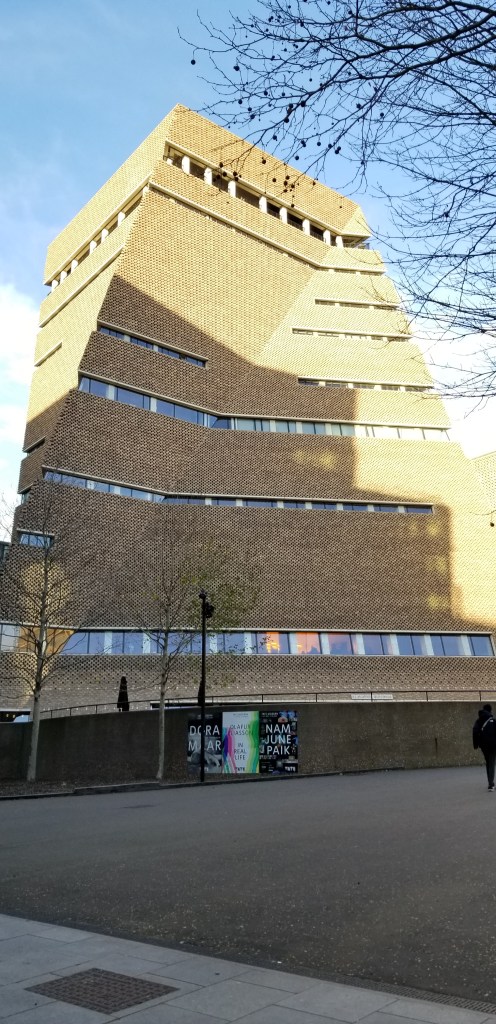
My favorite destination has been the Tate Modern. The museum is directly across from another destination we’ve been to, that being St Paul’s Cathedral. Tate Modern was originally made as a power station. The architect Giles Gilbert Scott worked for Battersea Power Station and he had built the building in two stages between 1947 and 1963. [1] It was later closed in 1981, then reopened as museum. The new structure built into the building is called the Switch House, it was finished and opened in 2016.
As a graphic designer we are taught when working with a business, the first step is when meeting with your client is to understand and feel their vibe and most importantly the location and setting you are going to be working in. As a designer it is important to see, feel, hear and smell what is around you. It helps you understand the culture of the company. Similar can be said to entering Tate Modern. When entering the front door, you seen this incredible downwards ramp that made me feel like once going down you were entering something special. The scene was also very modern and welcoming. As De Meuron, one of the architects for the Tate Modern states “There should be no safety rails in your architectural perception. You should be able to fall down.” This statement is unique to me because of the fact all modern art and architecture follows this flow of freedom and no safety.[2]
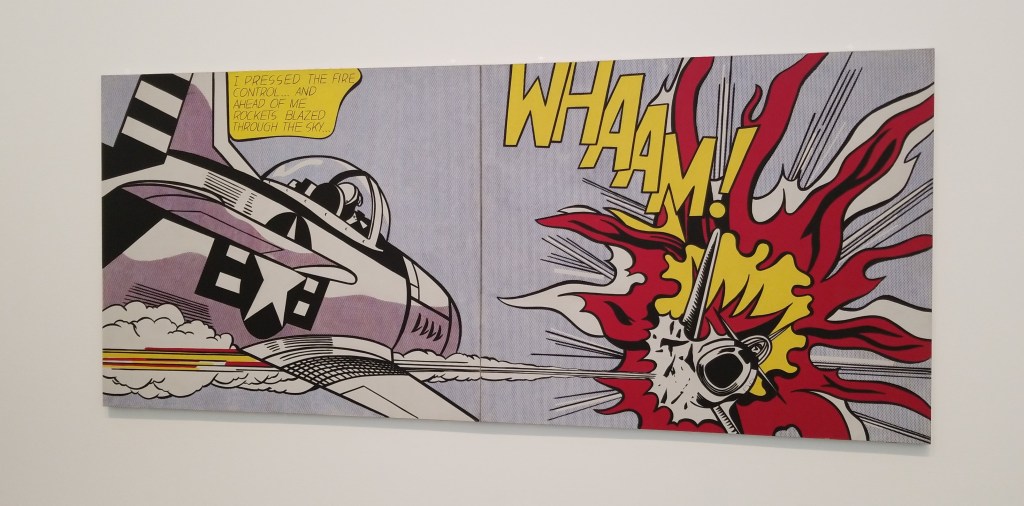
I enjoyed a lot of work at Tate Modern because of the modern and relatable artworks. Some of my favorites was Salvador Dali’s Lobster Phone because I have been to his Museum in Florida and since then he has become my favorite artist, strictly on color choice and creativity. Other favorites included Soviets Photobooks, Evelyne Axell’s Valentine, and Roy Lichtenstein’s Whaam!, and finally Aldo Tamellini’s Room which was incredibility creepy, however also incredibility exciting to experience.
[1] Tate. “Design.” Tate. Accessed January 7, 2020. https://www.tate.org.uk/about-us/projects/tate-modern-project/design.
[2] Moore, Rowan. “Herzog and De Meuron: Tate Modern’s Architects on Their Radical New Extension.” The Guardian. Guardian News and Media, May 15, 2016. https://www.theguardian.com/artanddesign/2016/may/15/herzog-de-meuron-interview-tate-modern-switch-house-extension.
SOVIETS PHOTOBOOKS
Soviets Photobooks
One of my favorite artworks so far has been the Soviets Photobooks. The Soviets posters were on display from 1923-1953. “Posters and publications highlighted the achievements of the young socialist state. Their aim was to reach both local and international audiences. Addressing areas including industry, technology, sport and culture, they emphasized rapid improvements in Soviet society.”[1]
What intrigued me most about these posters was the collaboration of photography, design and typesetting. As a graphic designer these three aspects are the fundamentals of design. This was a period of radical experimentation with publication and posters. This radical for of publication was achieved by the deep and powerful Soviet red color, the foldouts, cut-outs and flaps that brought the page to life. This transformed everyday subject matter into energetic compositions because of Photomontages, which showed a new perspective by the cutting and pasting images together. It combined photography with experimental design and striking graphics. Theses posters introduced the new form of “worm’s eye” view and “bird’s eye” view.
My favorite design of the Soviet Photobooks is Georgii Kibardin’s “We are Building a Fleet of Airships in the Name of Lenin” What I enjoyed most about this poster was the scale of the different layers. As a graphic designer I know that playing with scale represents power. As talked about in class an example of scale can be Cathedral at Monreale, where Jesus is much bigger than everyone else. Same can be said about this poster the man, who is most likely Stalin or Lenin is much bigger in proportion to than anything else on the poster, therefore representing that he is power and that the Soviets are powerful. Scale is also playing a factor in airships in the background. This poster strikes intimidation and power after the end of WWI and entering WWII that frightened other nations. [2]
[1] Tate. “Soviet Photobooks – Display at Tate Modern.” Tate. Accessed January 9, 2020. https://www.tate.org.uk/visit/tate-modern/display/artist-and-society/soviet-photobooks.
[2] Tate. “’We Are Building a Fleet of Airships in the Name of Lenin’, Georgii Kibardin, 1931.” Tate, January 1, 1970. https://www.tate.org.uk/art/artworks/kibardin-we-are-building-a-fleet-of-airships-in-the-name-of-lenin-p81647.
 Armando London